
The miami diss track That Was Actually a Lesson:
Jackson do Pandeiro and “Chiclete com Banana”
We picked this weirdly amusing photo montage lyric video, interpreted by the amazing Gal Costa to give more context. If you want to hear the Jackson do Pandeiro ultimate swag version click HERE
Real talk, who isn't guilty of dancing to songs that make you move first, and think later? “Chiclete com Banana” does both.
It is funny, catchy, a little sarcastic, and still has something important to say about what it means to love a culture enough to actually learn it. For us at Miamibloco, that lesson hits close to home, and is at the forefront of our mission.
A drummer who built his own rhythm
Before he became known as O Rei do Ritmo, Jackson do Pandeiro was known as José Gomes Filho, a kid from Paraíba in Brazil’s Northeast region. He did not come up through formal music schools or conservatories, but like many people simply considered music a part of being a human being. He worked different jobs, including as a baker, and learned music where so many powerful traditions are learned: in the streets, at fairs, in cabarets, on the radio, and inside community life.
He absorbed the sounds around him, including coco, forró, baião, rojão, and other Northeastern rhythms that much of Brazil was still learning to recognize.
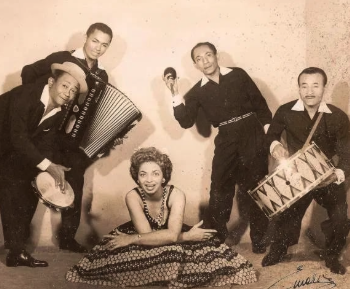
By the early 1950s, Jackson’s sound had found an audience. In the mid-1950s, he moved to Rio de Janeiro through a record-label opportunity and entered a city deeply associated with samba. But he did not leave his Northeastern musical identity behind.
Instead, he brought it with him: forefront and center.
Jackson strung coco, forró, baião, samba, and marchinhas in the same conversation. His phrasing was playful, deeply syncopated, and unmistakably his own. He was not trying to choose between regional music and urban music, or between the Northeast and his new home in Rio de Janeiro. He made the rhythms speak to each other, and opened doors … and ears through his daring musical experiment that was the simple act of showing pride for where he came from.
That is part of what makes “Chiclete com Banana” so brilliant, and another “Miami” name drop to include in your Miami playlist… except this one is a diss; but Oh, so catchy you might miss it.

Actual proof that it is possible.
The joke inside “Chiclete com Banana”
Written by Gordurinha and Almira Castilho, and recorded by Jackson do Pandeiro in 1959, “Chiclete com Banana” became one of the songs most closely connected to his legacy. It later reached even wider audiences through artists including Gilberto Gil, and was performed by Miamibloco’s Trio de Janeiro at the 6th annual Miamibloco Saideira Social on Memorial Day weekend 2026.
This song doesnt make you wait and discover; the title is already the punchline.
Chiclete, chewing gum, represents imported American culture. Banana represents Brazilian culture. Put them together and you get a strange little combination. That is exactly the point.
In the song, Jackson jokes that he will only mix American bebop into his samba only after “Tio Sam” picks up a pandeiro and a zabumba. He says he will blend “Miami com Copacabana” only after Uncle Sam understands that samba is not rumba.
It is a joke, yes. But it is also a serious cultural argument that we take very seriously in Miamibloco, hiding inside a party song.
Jackson is not saying that cultures should never mix. His entire career proves the opposite. He was a master of musical fusion. What he is saying is that exchange has to go both ways. Learning a culture with respect and dedication is a great way of experiencing new ways of understanding the world.
You cannot just “borrow” the flavor of a rhythm, call it a vibe, and skip the part where you learn what it is, where it came from, who carried it, and how it works beyond a technique.
If you want the sound, pick up the instrument, pick up a book, and definitely look for people from that culture that can help give you a vivid sense of the music, the words …
What we have learned in Miamibloco
This is where the song starts to feel very Miamibloco.
We have learned that authenticity is not about being born in a particular place, having the “right” last name, or claiming a culture without question. It is also not about putting on a costume, learning one break, and calling yourself part of a tradition.
Authenticity is practice. Samba in Miamibloco is not entertainment.
It is showing up prepared to rehearsal, even when the pattern is not clicking yet. It is learning how to listen before trying to play louder. It is understanding that the surdo has a role, the caixa has a role, the repique has a role, and the tamborim absolutely has a role in humbling you when you think you have it all figured out.
It is mostly about recognizing that if you know more than others, you help, not show off. And while the shows and public rehearsals are a vibe, a bateria is not built by vibes alone. Trust us.
It is built as a unit, under production and musical leadership that go hand in hand; one rehearsal at a time, one call-and-response at a time, one sweaty rep at a time. It is built by learning the history alongside the choreography, the groove alongside the language, and the joy alongside the responsibility.
“Miami com Copacabana” is not just a line
Miamibloco exists because we believe Miami can be part of this conversation with real respect.
Our community includes people from different countries, languages, ages, and musical backgrounds. Some grew up surrounded by Brazilian music. Some found samba later in life. Some arrived because they wanted to drum, dance, meet people, or try something that felt bigger than another workout class.
All of that is welcome.
But being welcome is not the same as skipping the work. The work is the invitation.
You earn your place in a rhythm tradition by learning it, practicing it, always crediting it, supporting the people who carry it, and staying curious enough to keep growing. That applies whether you are in Rio, Recife, Salvador, New York, Los Angeles, or right here in Miami.
Jackson do Pandeiro gave us a reminder that is still sharp more than six decades later: cultural exchange is beautiful when there is respect for the culture, reciprocity, and commitment behind it.
So yes, mix Miami with Copacabana. Just remember that playing samba goes way beyond having good technique.
Jackson do Pandeiro was victim of discrimination racism. Like many if not all popular cultural movements we get to enjoy in a globalized world, samba was built by the resistance of the people who show up to nurture and defend it then and now. We are proud of being part of the samba lineage through our work, and hope you join us in making this story richer and profound by becoming part of it.
